When "Gifted" Kids Hit a Wall, and How to Rewire Their Confidence

It's a specific, heartbreaking shift to watch in upper elementary classrooms and I saw it first hand with my own son.
For the first few years of school, your bright, intuitive students don't actually experience learning in the traditional sense. They just know. Their brains process information so rapidly that school acts as a stage where they go to demonstrate automatic excellence, rather than a workshop where they go to understand the unknown, make mistakes, and practice.
Then comes fourth grade.
The academic landscape undergoes a massive structural shift. The curriculum moves rapidly from concrete, operational tasks to abstract reasoning, inferencing, and multi-step problem solving. Suddenly, intuition alone isn't enough to get by.
For a child who has spent years equating "being smart" with "doing it perfectly on the first try," running into a wall isn’t just an academic hurdle. It's an identity crisis. When automatic success fails them, a baseline of self-worth fractures under the pressure.
The Hidden Psychology of the "Gifted Crash"
When an advanced child reaches the upper elementary grades without ever having to exert deep effort, they miss out on developing what we can think of as the psychological musculature of learning.
Because early milestones required little to no stretching, these students face distinct psychological traps when the material finally catches up to their natural baseline:
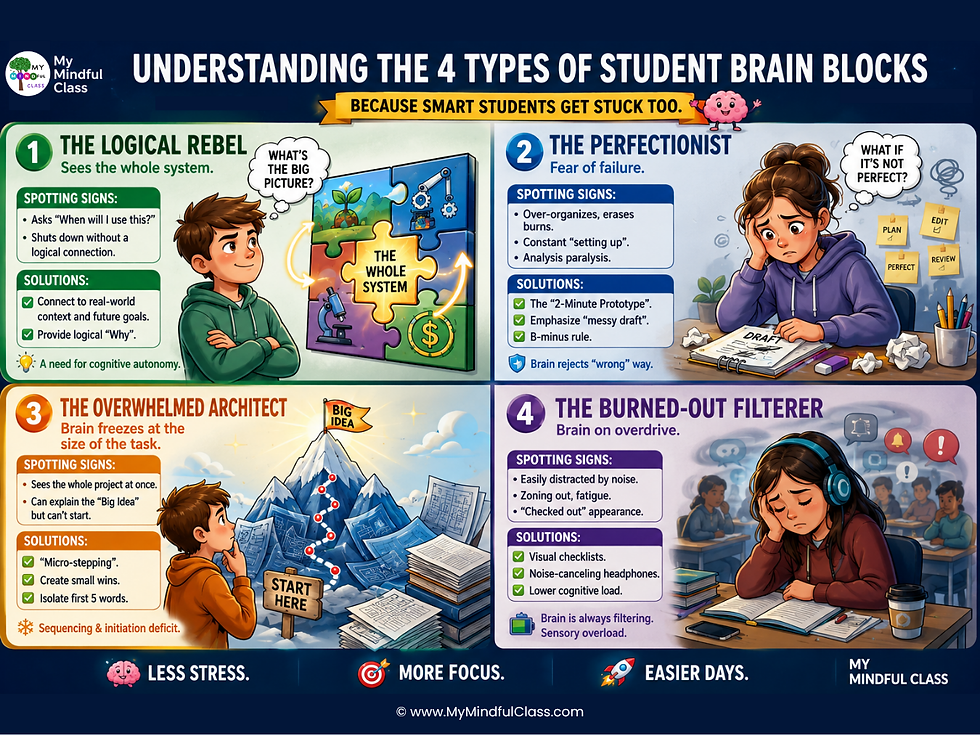
1. The Perfectionism Trap
When early success is effortless, children internalize a rigid, fixed mindset. They begin to view ability as a static, predetermined quantity. In their internal logical framework, the equation is simple: Smart = Easy. Therefore, if they have to slow down, write out steps, or practice a concept, their internal narrative whispers a devastating conclusion: If I have to try hard, it means I am no longer smart.
2. The Beginner Phobia
These students genuinely do not know how to be beginners. They lack a reference framework for the messy, unpolished, and awkward initial phases of skill acquisition. To a child stuck in this loop, not instantly mastering a concept feels like a permanent internal defect rather than a natural, temporary starting line.
3. Vulnerability Avoidance
Rather than risk failing or looking "average" in front of their peers and teachers, these kids will deploy defensive behaviors to protect their egos. They will shut down, act out, or intensely claim an assignment is "boring" when it is actually challenging. In the psychology of a perfectionist child, boredom is a much safer mask to wear than perceived incompetence.
Rewiring Student Confidence: Shifting the Anchor
When a child’s confidence is built entirely on being "the smart kid," it remains highly volatile. To protect that confidence during this inevitable developmental transition, educators and parents must intentionally shift the anchor of self-worth from outcomes to effort.
This shift requires changing how we deliver feedback in our classrooms daily. When we routinely offer praise like, "You're a natural at this," a student internalizes it as: "I am valued because this is easy for me." Instead, we can purposefully highlight the mechanics of their effort and stamina.
The Mindful Shift: If a student feels like they are failing because a concept requires effort, our job isn't to erase the struggle. Our job is to change what that struggle means to them.
Practical Classroom Tools for the "Applying Themselves" Phase
Supporting a student through this shift requires an approach rooted in high empathy and low friction. They need real-world life skills to manage the emotional frustration of practice just as much as they need the academic curriculum itself. Here are four strategies to implement in your classroom environment:
1. The Power of "Yet"
This classic growth-mindset tool transforms a permanent, rigid barrier into a temporary, navigable bridge. When a student drops their pencil and declares, "I can't do fractions," gently append the magic word: "You can't do fractions yet." It signals to their nervous system that learning is an ongoing path, not a closed door.
2. Scaffolding Micro-Steps
Gifted kids tend to see the big picture instantly and want to jump directly to a polished final product. When they can't get there in one massive leap, they panic. Break down a complex writing prompt or multi-step math project into tiny, explicit sections. Focus your feedback entirely on the first step to help them build small, incremental momentum.
3. Modeling "Beginner Status"
Demystify the process of skill acquisition and normalize visible vulnerability by letting your students see you try something completely new or difficult. Whether it's learning a new art technique, a complex rhythm pattern, or navigating a minor tech glitch, explicitly say out loud: "I am pretty clumsy at this right now, but I am practicing for ten minutes because that's how my brain figures it out."
4. Separating Emotion from Ability
De-escalate a perfectionist panic by validating the physical frustration without validating their self-doubt. Use this language layout to shift the perspective:
Instead of dismissing it: "Oh, come on, you're smart, this is easy for you!"
Try naming the pattern: "It is frustrating to have to slow down when you're used to flying through assignments. Let's take a two-minute breather, clear the slate, and tackle just the first line together."
Normalizing the "Gears" of the Brain
One of the most transformative concepts we can teach in modern mindfulness and life skills is that the human brain has different operational gears. Up until fourth grade, highly capable students have been cruising in overdrive on a completely flat, predictable road. Upper elementary simply introduces the hills.
Help your students realize that the heavy, uncomfortable feeling of confusion is not a symptom of failure. It is the literal, physical sensation of neural pathways growing and adapting. We can explicitly share this framework with our classrooms:
"When a task feels easy, you are simply practicing what you already know. When it feels hard, that is the exact moment your brain is growing."
By integrating these small, intentional structural shifts into our daily classroom culture, we transform a student's confidence from a fragile piece of porcelain into a resilient, lifelong tool for real-world success.
What strategies do you use to help your bright students push past the perfectionism wall? Let’s keep the brainstorm going in the comments below!

Comments