The Surprising Psychology Behind Student Avoidance
Why capable students procrastinate, shut down, overthink, or avoid tasks and what their brains may actually need instead.
You have a great lesson ready. Most of the class is moving. But one student is staring at a blank page. Another is arguing about why they have to do it. A third is "organizing" their desk for the twentieth minute in a row.
It looks like they aren't motivated. It feels like they just don't care. But usually, it’s not laziness. It’s a system error in their brain. When we understand the "why" behind the stall, we can help them start the engine.
When you shift your perspective to see these "stuck" behaviors as temporary system blocks rather than fixed personality traits, you transform the entire energy of your classroom. Instead of viewing a student as "oppositional" or "unmotivated," you begin to see them as a learner whose brain is simply requesting more logic, smaller steps, or a lower sensory load to feel safe enough to engage.
This shift moves you from a place of frustration to a place of curiosity, where you act as a guide helping them navigate their own mental architecture. By addressing these specific neurological needs, whether it’s providing a clear "why" or offering a two minute "messy" draft, you remove the friction that causes procrastination and avoidance. The result is a learning environment built on trust and emotional intelligence, where students feel seen and supported enough to move from paralysis into the focused, motivated action you’ve been looking for.
Here are the four most common "stuck" types and how to get them back on track.
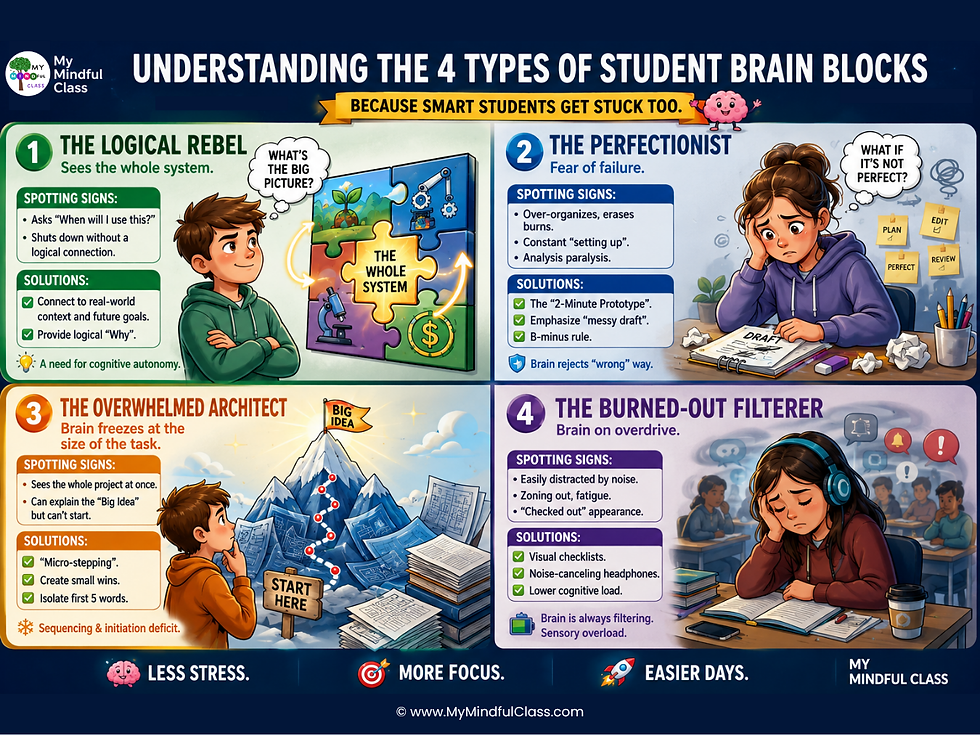
THE LOGICAL REBEL
The Student Who Needs the "Why"
These students aren't trying to be difficult; they are simply unable to commit energy to a task that feels "meaningless" to their brain. How to spot them: They ask "Why are we doing this?" or "When will I use this?" If they don't get a good answer, they shut down. They aren't being difficult. They are looking for a reason to engage.
The Solution: Future Pacing. Before they start, show them the finish line. Don't just say "it's for a grade." Tell them how this specific skill helps them solve a real-life problem later. Give them a logical anchor by connecting the assignment to a personal interest or a real-world problem they care about.
The Choice: Give them two ways to show they learned the concept, giving them a sense of autonomy over the "system".
THE PERFECTIONIST
The Student Stuck in Analysis Paralysis
How to spot them: They spend forever setting up. They sharpen pencils or ask a hundred questions before writing a word. They are terrified of doing it the "wrong" or "inefficient" way. They ask for excessive clarification on tiny details before they even begin. They ask for excessive clarification on tiny details before they even begin.
The Solution: The "Rough Draft" Timer. Set a 3-minute timer and tell them, "During this time, you have permission to be messy and make mistakes". Tell them the first version is just a "messy draft.” Done is better than perfect. Once they start, the fear usually fades.
THE OVERWHELMED ARCHITECT
The Student Lost in the Big Picture
These students see the "mountain" of the project and their brain shuts down because they can't find the first "rock" to step on.
How to spot them: They can't find the first step because they are too busy worrying about the last step. This leads to total paralysis. They look physically frozen or "locked" when you hand out a multi-step project. They can explain the "big idea" of what they want to do perfectly, but haven't actually written a single word. They get distracted by the "last step" (like how to staple or turn it in) before they've even started the first step.
The Solution: Micro-Stepping or the "first five". Give them one small win. Ask them to tell you the first five words they are going to write, then walk away so they can get them down without pressure." When they finish, celebrate that win and show them the next one.
THE BURNED-OUT FILTERER
The Student with a Full "Mental Cup”
These students are working ten times harder than their peers just to manage the environment around them.
How to spot them: They are productive in the morning but become irritable, foggy, or "lazy" after lunch. They look "checked out." By the afternoon, they have nothing left. Their brain is working so hard just to filter out the noise of the classroom that they have no energy left for assignments. They are easily startled or distracted by small noises, like a humming light or a classmate's tapping. They frequently ask to go to the bathroom or the nurse just to get a break from the "noise" of the room.
The Solution: Lower the Load. Keep it simple. Give them a written checklist so they don't have to use mental energy remembering your verbal instructions. Small steps with big impact start with a quiet mind. Provide a quiet zone by offering noise-canceling headphones or a "low stimulation" corner for work time to lower their cognitive load.
Awareness is the Bridge
When you treat these as "brain blocks" rather than personality flaws, you stop being the person who "makes them work" and start being the person who "clears the path". These students aren't trying to fail. They are just waiting for a system that works for their brain.
Try picking one "stuck" student tomorrow. Don't push them to work. Instead, try to find their block. It is the fastest way to less stress and easier days for both of you.
Less Stress. More Focus. Easier Days.
My Mindful Class


Comments